Blog

The Ultimate B2B Guide to Cargo Insurance: Coverage, Policies, and Claims

2026-04-16 - Leave me a message

Risk is everywhere during international transit. Whether you are shipping standard containers or multimillion-dollar oversized project cargo to Africa, understanding Cargo Insurance is not optional—it is a critical component of supply chain security.

What exactly does cargo insurance cover? How do you choose the right policy? What happens when a claim arises? In this comprehensive guide, SPEED INT'L breaks down everything you need to know about marine and freight insurance.

1. The 12 Key Elements of an Insurance Contract

An insurance policy acts as a "risk map," detailing who is covered, what is covered, and the exclusions. A standard cargo insurance contract includes:

  • Policyholder (Applicant): The party purchasing the insurance.
  • Insured: The party entitled to claim compensation.
  • Subject Matter Insured: The actual goods being transported.
  • Voyage/Routing: The planned transport path.
  • Conveyance: The vessel, flight, or truck details.
  • Limit of Liability: The maximum payout amount.
  • Basis of Valuation: How the goods are valued.
  • Insuring Conditions: The specific clauses applied (e.g., ICC A or C).
  • Exclusions: What is NOT covered.
  • Deductible (Excess): The out-of-pocket amount before insurance kicks in.
  • Insurable Interest: The financial stake in the goods.
  • Validity Period & Locations: Origin, destination, and dates.

2. Policyholder vs. Insured: What's the Difference?

The Policyholder is the entity that signs the contract and pays the premium. The Insured is the entity whose financial interests are protected and holds the right to claim compensation after an accident.

In B2B cargo insurance, the Insured is typically the enterprise owning the cargo (the Shipper or Consignee). Note: Claim payouts are strictly made via corporate bank accounts, not to individuals.
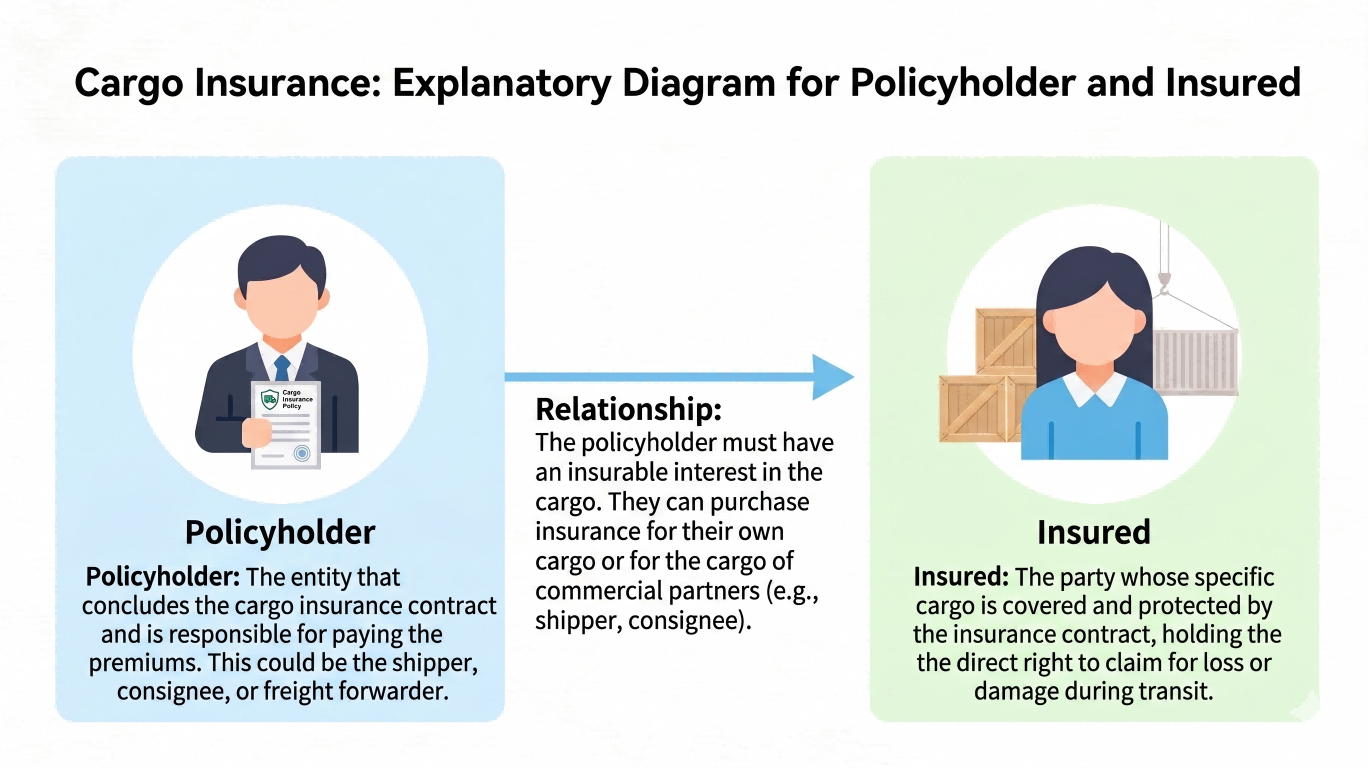
Policyholder vs Insured in Cargo Insurance

Fig 1: The relationship between the Policyholder and the Insured.

3. Choosing the Right Clause: ICC (A) vs. ICC (C)

The two most common international marine insurance clauses are:

Institute Cargo Clauses (A) - "All Risks":
Provides the broadest coverage. It covers all risks of loss or damage to the goods, minus specific exclusions. Ideal for most new, high-value commercial goods and project cargo.

Institute Cargo Clauses (C) - "Basic Risks":
Provides narrow, named-peril coverage (e.g., major disasters like fire, sinking, overturning). Often used for second-hand goods, raw materials, or specific inland transit legs.

4. How Much Should You Insure?

The insured amount is the basis for premium calculation and the maximum payout.

  • International Trade Standard: It is standard practice to insure goods for 110% of the Commercial Invoice Value. The extra 10% covers the anticipated profit and hidden costs of replacing the goods.
  • Under-insurance: If you insure goods for less than their actual value, payouts will be proportionally reduced.

5. Crucial Steps for Claiming Damages

If your cargo arrives damaged, taking the wrong steps can void your claim. Follow this protocol:

  1. Never sign a "Clean Receipt": If you notice external damage upon delivery, note the abnormalities on the delivery order (DO) or Bill of Lading.
  2. Record Container Seals: If the container seal is broken or does not match the documentation, take photos and retain the physical seal.
  3. Notify the Carrier: For ocean freight, notify the carrier within 3 working days. For air freight, within 7 days.
  4. In Case of Theft/Accidents: Call the local police immediately to obtain an official incident report.
  5. Mitigate Losses: Take reasonable measures to prevent further damage to the cargo.

6. Required Documents for Filing a Claim

To expedite the claims process, prepare the following complete documentation:

  • Original Insurance Policy or Certificate
  • Bill of Lading (OBL) / Air Waybill (AWB)
  • Commercial Invoice & Packing List
  • Damage Report / Tally Sheet / Exception Report
  • Clear photographs of the damaged cargo and container
  • Written claim letter submitted to the responsible carrier
  • Police or Traffic Accident Report (if applicable)

Secure Your Critical Supply Chain with SPEED INT'L

Cargo insurance is not just another line item; it is an essential component of professional risk management. Understanding the fine print ensures your B2B bottom line is protected. As a certified NVOCC, SPEED INT'L offers expert guidance on securing your heavy lift and commercial shipments to Africa.

Get a Secure Shipping Quote

Send Inquiry


/* 彻底隐藏顶部搜索框及其外层容器 */ .head-search-bg, .head-search { display: none !important; }
X
We use cookies to offer you a better browsing experience, analyze site traffic and personalize content. By using this site, you agree to our use of cookies. Privacy Policy
Reject Accept